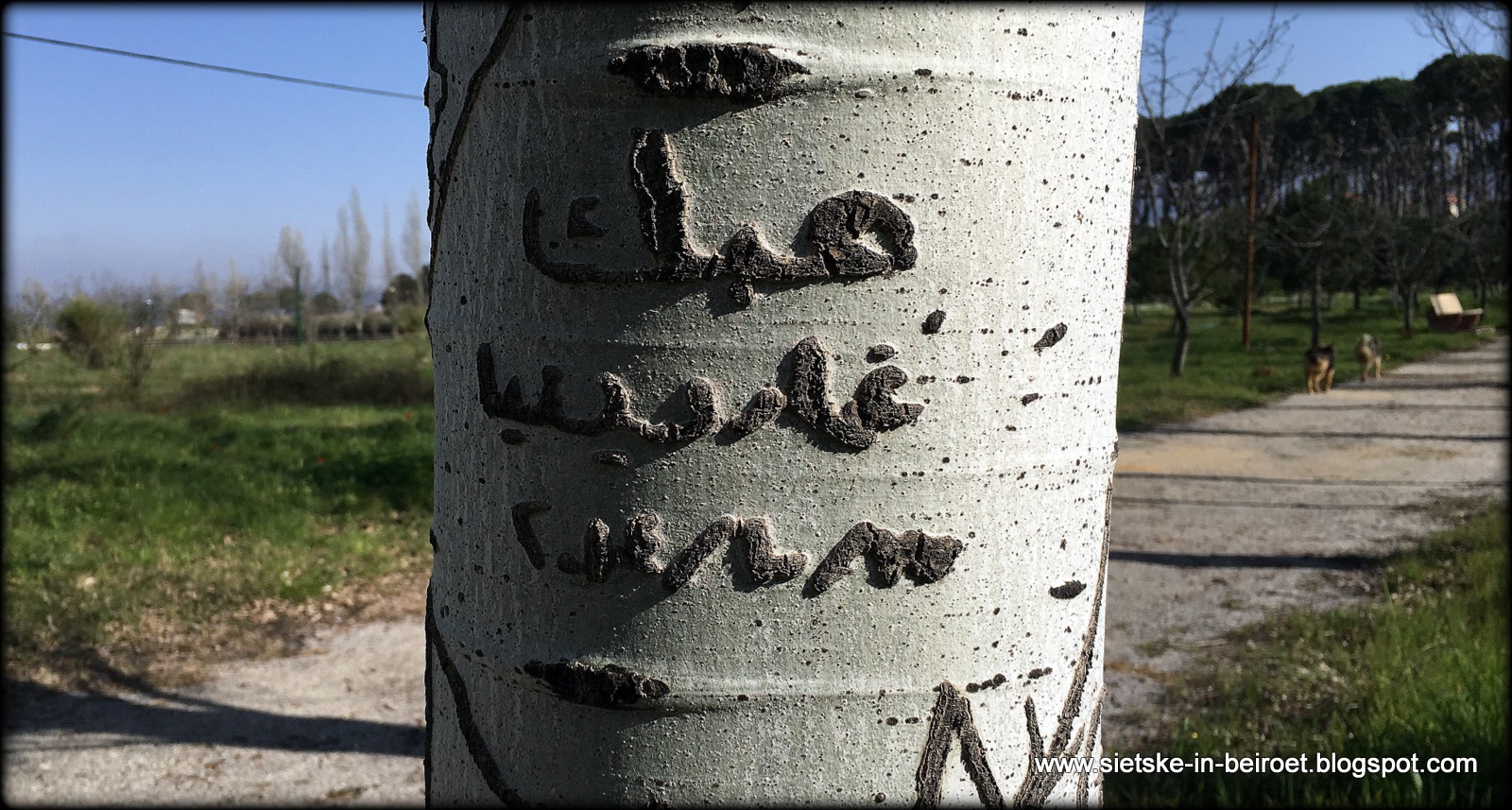
December 06, 2009

Beirut Marathon

Today was the annual Beirut Marathon. I was supposed to run the 10 K, but forgot to sign up. Yep. As the non-participation greatly impaired my chances to win, I figured I might as well not run at all. The weather was pretty miserable too. Nevertheless, it seems some 30,000 people participated. My son ran too, and we went to cheer him along
It seems the Prime Minister and the president also ran the 10K, but I saw neither one of them. The Ethiopians won both the men and the women’s title.

December 05, 2009

Sinterklaas in Beirut

The first loot is in.
Sinterklaas (the Dutch Santa Claus, which is celebrated December 5th, and on which the American Santa Claus is based) and his ‘zwarte pieten’ just passed by the little Dutch children in Beirut to drop off a load of gifts before he travels to Holland tonight where it is the traditional ‘Pakjesavond’ (gift-exchange evening). Sinterklaas with one of his helpers on the left (Do I detect Julia under the black paint?), and three little Dutchies on the right. The cross on the guy’s mitre seems to be a bit of an issue in the multi-cultural society of Holland. Some people feel that this might not appeal to Dutch children with an islamic background. I know; we Dutch can be immensely silly sometimes.

The annual visit of Sinterklaas to Beirut is a big event for the Dutch community. The children like it because they get to see Sinterklaas, a person of magical and mystical stature. The gift, of course, helps a lot as well. The Dutch ladies like it because this is the official start of the mulled wine season, and there’s some nostalgia in it as well.

Mind you, some of us are getting old enough to get even nostalgic over these Beirut visits of Sinterklaas. Kids that we remember as little toddlers crawling in between the wrapping paper are now taller than us, ask us whether we’ve seen their new car outside and drive us around instead of us them (are you following my grammatical incorrectness?). And little girls that used to cry before Sinterklaas have now become the Sint's politically incorrect black helpers. Time sure flies.

And now it is time to get ready for the next guy; Santa Claus.
She still believes in Sinterklaas. He doesn't; the boy is taller than Sinterklaas, but he knows that if he shows up, he's got to get a present.

Zen & Art of Dealing with Government Institutions

I’ve been quite proud of my Zen-like disposition today.
This morning I was supposed to pick up 1) my long-awaited son’s Arabic Exemption paper (Courtesy of the Ministry of Education), 2) the Arabic equivalency of my Dutch BA (Courtesy of the Ministry of Education) and 3) renew the work permit of my housekeeper (Courtesy of the Ministry of Labor).

Needless to say I returned home empty-handed. Totally empty-handed!

The Arabic exemption paper can only be picked up Monday through Thursday. “It clearly states on the paper,” said the lady on the 2nd floor of the Ministry of Education. Well, that’s in Arabic, but I only have to blame myself.

The equivalency paper could not be processed because the fax number I had given of my Dutch university was not working. That is a bit of a story as well. The head of the Exams Committee of my university had to take a stroll through the admin building in order to find a fax machine. “You guys are still using fax machines?” he asked me in surprise, when I asked him for a fax number. But apparently the one he gave me was no longer in order, and now we will try it through e-mail. “But then you have to wait for the secretary of the boss to come back,” says the lady of the Equivalency Desk. “The boss can do the fax himself, but for e-mail he needs the secretary.” Need I say more?

And the work papers? “Oh, you have to go through Liban Post,” answered the gentleman at the desk of the Ministry of Labor when I asked him how to go about renewing her work permit. LibanPost, eh? Well sure, why not. However, they close at 1:00, and so I went home.

At no point in time did I raise my voice, sigh, roll my eyes or be impolite in some other non-verbal way. You should have seen me; I was Zen aaaaaaaaall over!

This picture is unrelated to this post. I took it some time ago in Bourj Abu-Haidar, a neighborhood wedged in somewhere between Mar Elias and another neighborhood which name escapes me now. It is a home-made solution to someone in that alley that is obviously a wheelchair occupant.

November 29, 2009

More Slow Days

Our swine flu victim is on the better hand. And despite coughing and sneezing fervently in the faces of everyone in this household, no one else is willing to go down with what has been described as a ‘highly contagious’ virus.But as I am advised not to take her out of the house yet, I’ll leave you (yet again) with pictures of earlier events. These are taken on the cliffs of Shikka, north of Beirut.

November 27, 2009

Slow Day

It's a slow day today. Some are celebrating Adha, a few are celebrating Thanksgiving, and I'm preparing for Sinterklaas (Saint Nicolas) next weekend.
Sinterklaas will arrive to Beirut on December the 5th. Tineke, our ‘lady of the Saint’ , had some difficulties locating a ‘Saint’ this year. Our usual man was off to Pakistan, I believe. His replacement had urgent business in Aqaba, but she managed to get hold of a ‘suitable’ Saint, and thus, next weekend, he will appear, with a big fat cross on his mitre (bishop’s hat), in front of all the little Dutch, and half-Dutch children. My swine flu victim is currently keeping me indoors, and so I’ll leave with some ‘still-lives’ of Ashrafieh.

November 26, 2009

Sick as a Dog

Sick as a dog, she is. The Minister of Health has announced that of all flu cases in Lebanon, 80% are H1N1. None of the hype you read about in other Middle Eastern countries is taking place here. I was pleasantly surprised about that. I remember a solar eclipse a couple of years ago. You’d think the world was coming to an end. No one ventured out for some 4 hours.
But this swine flu is not getting the Lebanese down. It’s a flu. We get flu all the time.

About half of Hana's class has been out already with fly symptoms. The neighboring school has had to close one section for a week because the student body was ‘infected.

And yesterday was her turn. 40 degrees fever. My children become extremely eloquent and polite when they have a fever. I don’t know what it is, but they become quite pleasant.

But with all this hype about swine flu, I call her doctor.
Should I worry?, I ask him.

“About what,” he asks me. “Worry whether it is the swine flu? Well, if it is, what are you going to do about it? She’s got the flue. I can’t do anything about that either.”

I like a level-headed doctor. The Dutch in general do not like to medicate their children. Better to ‘sick it out’, and build up a resistance. I took me quite some time to find a Lebanese doctor who understood that cultural quirk.

“It’s green,” says the doctor, “I got to go. Call me if it gets any worse.”

November 22, 2009

Trip to Tripoli

Skyline of Tripoli (northern part).
You can see the crusader castle on the right (yes, I'll provide a microscope), and the old souqs in the middle.

We have this very old, trice-removed aunt in the family, that recently moved from Zghorta to Tripoli. We went to say ‘mabrouk’ (congratulations) for the new house.

Whenever I go to Tripoli, I am reminded that I live in the Middle East. This may be obvious to you, but when you hang around Beirut and surroundings, it’s all very western. Even in the south it is pretty much familiar. So you tend to forget at times at times that you in fact live in a totally different culture. But whenever I go Tripoli, I am surprised by the ‘Arab’ness of the place. It reminds me of Cairo, which is a #10 on the ‘Arab’ scale, whereas Beirut would rank as a #1. Damascus is somewhere around a #6.
Abu Samra, a popular neighborhood, which is a bit of a hotbed now and then for sunni fundamentalistsThree girls reading a book on the steps

So Tripoli is (for me) the only city in Lebanon where I get reminded of the Arabs as a culture. I find that quite intriguing. It is almost like traveling abroad when I go there. Maybe it is because Beirut got partially destroyed by both the Israelis and the Lebanese themselves. Tripoli – although it has seen its share of fighting – was left pretty much intact, and as such is original.
Tripoli is dustier. Simpler. More men on the streets than women. More pious maybe. More real. And definitely poorer than Beirut..

The Saint-Gilles Citadel

From this old aunt’s (new) balcony, you have an incredibly view; all the way from the cliffs of Shikka to Syria, and right over the old town.
The old town is interesting. Tripoli is known for its traditional souqs, and the one in Tripoli remind me of medieval cities.
But what I find (from a European point of view) much more interesting is the crusader castle. There’s a crusader castle right on her street! The Saint-Gilles Citadel (Qal’at Sinjil in Arabic).

Castle entrance

It’s close to 900 years ago that Raymond de Saint-Gilles – originally from Toulouse – came with the first wave of Crusaders in 1099, occupied Jerusalem, and then besieged this exact hill, overlooking the old town and the sea. He called it Mount Pellerin, and wanted to turn it into a fortress. He died there 3 years later, still laying in siege. They finally got it in 1109, and had a citadel built. The original castle burnt down some 180 years later, in 1289, when the Mamlukes threw them out again.

With a little imagination, you could assume that these cobblestones have been here for about 1,000 years. The steps into the castle are very similar the ones in Crac des Chevaliers; they’re low enough for horses to climb them.

It is so weird to look at a monument that less than 1,000 years was part of a massive movement of Europeans, mainly Franks, moving into the Middle East and occupying large parts of current Israel, Syria and Lebanon. Apparently Tripoli thrived quite well under the ‘Franks’.Wooden doors covered with sheet iron, and nailed tight

From Wikipedia: ‘Tripoli was home to a busy port and was a major center of silk weaving, with as many as 4,000 looms. Important products of the time included lemons, oranges, and sugar cane. It is curious to reflect that for 180 years, during the French rule, Langue d'Oc, the language of Provence, was spoken in Tripoli and a neighboring village, owing to the influence of a number of Provencal nobles and courtiers who came here.'

When you speak to Palestinians here in Lebanon, at least the ones that know their history, you sometimes discuss the fact that it has been so incredibly long since they’ve lost their land, 60 years for most, so aren’t they about to give up on this dream of returning? I mean, 60 years; the fourth generation is announcing itself already!
And then sometimes they answer that in retrospect, 60 years is nothing. The crusaders were here for more than 200 years, and what’s left of them? Indicating that Israel may have been around for some 60 years now, but who says they’ll still be there in 140 years from now?
It is an odd thought, but nothing ever stays the way it is, and so for them, this is not permanent.

I’m from a generation where the only thing that ever changes was the Berlin Wall. Other than that, everything has been as it was since I was born. Well, and we got Internet.

The castle had maybe 8 visitors while we were roaming around. Keep an eye on your small children though. They do not believe in fences in this one.

The surroundings of the castle have ‘urbanized’ slightly since 1099, I imagine. All the orchards have gone, and there’s not much green in sight anymore. The Abu Ali River, which runs in the valley under the castle, has become a bit of a sewer canal.

The castle is not very well maintained. Another 100 year and there will be nothing left of it if they don’t take care of it. From the castle, you get a good view of the ‘other’ side of the Abu Ali River. It seems there was a crusader castle in Beirut as well at some point; a print shows the ruins. The stones have been re-cycled into other building projects since then. Just like the crusaders probably picked them up from earlier civilizations.

The 'other'' side of the Abou Ali River. Apparantly kind of a 'wrong side of the track' neighborhood (I've been told, don't quote me on that).

Well, that’s enough history for today, which happened to be the Lebanese Day of Independence. And which I chose to ignore. Quite wisely I might add. Tripoli was much more fun.

Meet the old -trice removed - aunt from Tripoli. I was trying to explain my daughter how humans ‘evolved’; every generation grew just a little taller than the generation before. I’m afraid she’s going to have a ‘skewed’ understanding of this concept, after meeting this old aunt. The 70-something year old lady is as tall as my 6 year old, and half as tall as my 15-year old.

November 21, 2009

What Did He Do?

West-Beirut; this afternoon.
The first thing that comes to mind is that this guy REALLY messed up. Did he forget her birthday? Her Mom’s birthday?Is her name Tamara? Samantha? Did he get caught cheating? Did he stand her up at the altar?
What did he do that got her so upset that he had to go for a public apology?
I am dying to know.

November 19, 2009

Another One?

Beirut is born-again. From the London Evening Standard. I am telling you; this is a CONSPIRACY!

November 18, 2009

Fossil Hunting

Some people travel in style. Their car upholstery looks like they bought the car yesterday, and they only have a box of Kleenex on the dash board.
When you open my car, things roll out, and you first have to pick up the garbage from the floor before you can get in. My car looks like someone lives in it. Mind you, I only use it on the weekends.
Stacked to the roof, like a Syrian mini-bus.
That’s the same when we’re on the road; it’s like on one of those mini-busses from Syria is crossing your path. I’ve got s#*@ packed all the way up to the roof. I’m in this mind-set that anything could happen. Like extra sets of clothing (it's not that someone might fall in the water; in my family someone WILL fall in the water), a first-aid kit, (someone else will fall a hole in their head), food (someone is always hungry just when we pull out of a restaurant), a Swiss knife (never needed it), a Leatherman (never used either), and blankets (what if we get stuck somewhere overnight? Never happened, but what if?) . I’m sure I have more, like wet wipes, sun screen, you name it.
Bare mountains

This weekend we went biking. 4 kids (not all mine) and so 4 bikes. We went to Zaarour. Not all of Lebanon is nice to look at. There are some regions that are just… bare.
Zaarour is one of those places. I never understood the charm of the place, just like I don’t get it why people go up to Feraya in summer. To do what? There’s nothing there. Not one single tree.
A abandoned animal stable (?)

Zaarour has another odd thing; it’s a private mountain. I had never heard of anything like it before I came to Lebanon, but over here, you can actually by an entire mountain and then make it off-limits to everyone else. A group of people have organized themselves into a cooperation that has bought a mountain. They’ve installed ski-lifts, chalets, an infrastructure and a barrier. So only the owners can come and ski here. Faqra Club is another one of those resorts, where people have basically bought a mountain, or a hill, whatever you want to call it, and turned it into a private ski resort.
Like a bunch of red-necks; give them a puddle and they either throw stones in it or they'll pee in it.

So the upper mountain of Zaarour is off limits to everyone except the home owners. Why they never bothered to re-forest the region is beyond my comprehension. I understand that pine trees won’t grow there, because the soil does not contain enough iron (although pine trees grow all the way from Rabieh up to Bois de Boulogne, which is the entire region between Beirut and Zaarour), but you can plant something else, no?
So the hills are bare, and the mountain formation not very spectacular. But my SIL has a place there, and the kids wanted to picnic, but she has a 1.5 month old baby, so Zaarour was the most convenient ‘outdoor’ option.

Fossils; this bunch was found in under ten minutes by 4 children.

What we did discover, however, was a massive amount of fossils. Not fish fossils, but shell fish. Lebanon used to be a tropical sea, the Thethys sea. That was some 220 years ago. Look what we picked up in less than 10 minutes?

According to this site: Lebanon's geological structure dates from the Cretaceous and Jurassic periods (146 to 65 million years and 206 to 144 million years ago). Fossils obtained from Lebanon generally belong to these periods. In particular, much of the Lebanese mountains consist of sedimentary rocks that are ideal for the preservation of fossils. Rock strata close to the surface contain large numbers of coral and sponge beds, as well as the fossil skeletons of a range of Jurassic crustaceans.

An AUB sites states that The Lower Cretaceous sandstone (…) has a number of bivalves and gastropods in it, particularly at specific levels. There are some ammonites in the higher beds.(…) There a useful little guide book to local fossils is 'Les Fossiles du Liban: Guide Practique' by Arslan, S.; Gèze, R. and Abdul-Nour, H. published in 1995.
And so we ended up fossil hunting all afternoon. We sort of forgot about the bikes. Never mind that I carried 4 of them all the way up that darn mountain.

November 17, 2009

Hot for 2010: Lebanon

From yesterday’s Times: Beirut may be the number-one place to visit in the whole world, but the rest of the country is now our top tip for a cool holiday

Hmm, if I think we are going to get any more publicity like this, we are going to get jinxed. Mark my words!

From The Observer.
From The New York Times

November 14, 2009

Pelicans over Beirut

I’m on the balcony, making pictures of the clouds. I can never get enough of clouds. Or horizons.
Hubbie joins me and says “Nice birds, eh?”
Birds? I see no birds.
There, those pelicans up ahead,” and he points to something in the sky.
Pelicans? He must be losing it, I think.
Those are no pelicans,” I say, when I finally spot them too. “Those are storks. Storks migrate. Who has ever heard of pelicans in Beirut?
I tell you, those are pelicans.”
He gets out the binoculars, and sure enough, there’s this flock of pelicans circling right above Beirut. We have huge swarms (or flock, I should say) of storks every spring. They soar around on the air current.
But I’d never seen pelicans. White pelicans, to be exact.

The Middle East, located at the juncture of three continents, Europe, Asia and Africa, makes it a region second to none in the world for tracking, research and study of the phenomenon of bird migration. The Middle East is a “bottle neck” for the migration from Europe and to Africa and back. More than 500 million birds pass over the Middle East twice a year in the autumn and spring migration. Source

And apparently the white pelican is quite a common traveler, although it’s the first time in 18 years I’ve seen them in Lebanon. You learn something every day.

They migrate from somewhere in Europe or Asia, to Africa, along the Eastern Mediterranean coast. Beirut is sort of jutting out into the sea, and so if you go in a straight line, you end up right above my neighborhood. You can see that in this shot I took this afternoon while coming down from the mountains. The sea goes around Beirut.
And another one of the Corniche this afternoon at 4:45 P.M. Can never get enough op that one.

November 13, 2009

Dutch Man Arrested at Beirut Airport for Smuggling Drugs

Now and then you read things that get your attention. From today's newspaper:

Security forces at Beirut airport arrested a Dutch man who was trying to smuggle drugs to the Netherlands, the National News Agency reported Thursday.NNA said that suspicion fell on Peter F., 68, when he was passing through a detection machine at Rafik Hariri international airport before boarding a Turkish airlines plane bound for Amsterdam.ISF personnel searched his handbag, which turned out to have an addition layer at the bottom and inside it 10 kilograms of hashish, NNA said.The news agency added that security forces immediately arrested the man and referred him to the central drug control bureau for further investigation.

AnNahar link
Daily Star link

A certain Peter F. was arrested at Beirut Airport with 10K of hashish.
And I am thinking: Why would anyone want to smuggle hashish to Holland, when you can by this stuff in Holland legally? Well, maybe not in quantities of 10K, but heck, you can’t smoke 10K away THAT fast. By the time you’re halfway, the remaining stuff will be old.
And at the age of 68? Maybe one of the old hippies?
I know just about everyone in the Dutch community, but no 68 year old Peter F.’s. I know a Dutch Peter in Beirut, but he’s like 35. I know 68 year old Dutch men in Lebanon, but none of them is a Peter. Maybe one of the Dutch ladies stuffed it secretly in her dads luggage as he came over for a holiday? I know one who would be very capable of doing just that, but her dad is not a Peter either.
With 10K we can assume that he’s not going to smoke it himself, so who’s he transporting this for? Maybe he has his own coffee shop? But at the age of 68? I know that in Holland the government is trying to push the retirement age from 65 to 67, but that’s not this year. So who does Peter know that I don’t know? Just when certain organizations are accusing other organizations of using certain agricultural produce from the Beqaa Valley (nudge nudge) to finance their operations? Hmmmmm.

Intriguing, no?

More on the Dutch law on drugs (opium wetgeving) here.

November 12, 2009

Beirut is back… and it's beautiful

How the Lebanese capital went from warzone to 2010's most glamorous tourist destination . . .

From the Observer. Read the rest here.

As it turns out, the lights are a mixed success: some people stop, some people don't. A very Lebanese solution. You can do what you want, but you may have a super-charged Lebanese yuppie ram you in the back. Ah, yes, the memories come flooding back. It's that signature Beirut cocktail of adventure and excitement ? with just a hint of sudden death.
(...)the hotelier behind Le Gray, tells me about going out for dinner and being offered bluefin tuna. "I said, 'Isn't that an endangered species?' And the host leaned over and whispered, 'Not here'."
"In Lebanon," says Khaled, leaning back and spreading his arms out in an expansive fashion, "we have everything. We have the Mediterranean. We have classical ruins. We have..."
"Religious extremists," I say. "Armed militiamen."
"Exactly. If you want religious extremists, we have religious extremists. If you want mountains, we have mountains. If you want lingerie shows on the ski slopes of Mount Lebanon, we have lingerie shows. We have everything. Everything."
And the New York Times is right: it should be your number one destination.

Hey, I've been telling you guys this for some 4 years now.

November 11, 2009

The Corniche

4:45 this afternoon.
I know they have Corniches in other parts of the world. In Alexandria, for instance. Lots of Corniches in Egypt, by the way. Or like the one in Nice, France. They call that one the Grand Corniche, because it runs all the way to Menton.I once got kicked out of Menton by the police with a boyfriend. Or was that Monaco? Never mind. That sure was a long time ago. Anyway. Back to the Corniche in Nice. It may be ‘Grand’, but it can never be like the one in Beirut.
I took the long road from work this afternoon, and walked the Corniche, on account of the lovely mellow weather. And the legs. Did I just say that? Ignore that one as well.